

If you find this article interesting, click the like button for me! I would greatly appreciate it :)

Math Of A Loss
The standard investment advice is a buy-and-hold approach. Never selling and riding out all downtrends is marketed as the optimal investment strategy. A recent piece by Lance Roberts explains this argument well, and for a few reasons. Losses are not symmetrical, volatility drag reduces actual returns, and time is not on your side. A 50% drawdown needs a 100% gain just to get back to even, and a single bad year drags down the compound annual growth rate (CAGR) precipitously. Volatility drag suggests that repeated up 10% and down 10% loses money over time. After large corrections like the 1929 and 2000 peaks, it took investors roughly 15-25 years to recover.
This is especially important for those nearing retirement, when heavy losses can destroy retirement plans and that wealth cannot be recouped with 10+ years of income. Younger people have that luxury, but it does not mean it is good for them either. For a 30-year-old with $50k invested, a $25k haircut is a missing $1.1 million in retirement (10% compounded over 40 years).
With valuations such that expected 10-year returns are muted or even negative, it is especially prudent to monitor risk. The avg market compound annual growth rate since 1972 is 11.2%. The market doesn’t typically return 11%, though, as it encompasses the inflationary 1970s, the 1987 crash, the 2000 tech bubble, and the 2008 financial crisis. The market is actually extremely volatile, but we have been in a period of calm and a strong bull market since 2009.
If there were a way to avoid these losses and keep your capital, wouldn’t it be too good to be true? Ideally, that’s what The Gray Area Model Portfolio is doing, and is so far. I’m human, though, and could technically make a mistake. What if there were a rules-based trustless system that allowed you to avoid the major losses and stripped out human error and emotion?
Diversification
Money managers often use a 60/40 stocks/bonds approach. This is supposed to be all the diversification you need. The volatility, drawdown, and risk-adjusted return are better, so it is serving the correct purpose. Unfortunately, the CAGR is much worse, going down to 9.4% from 11%. That’s $2.8mil vs $1.2mil since 1973, markedly worse.
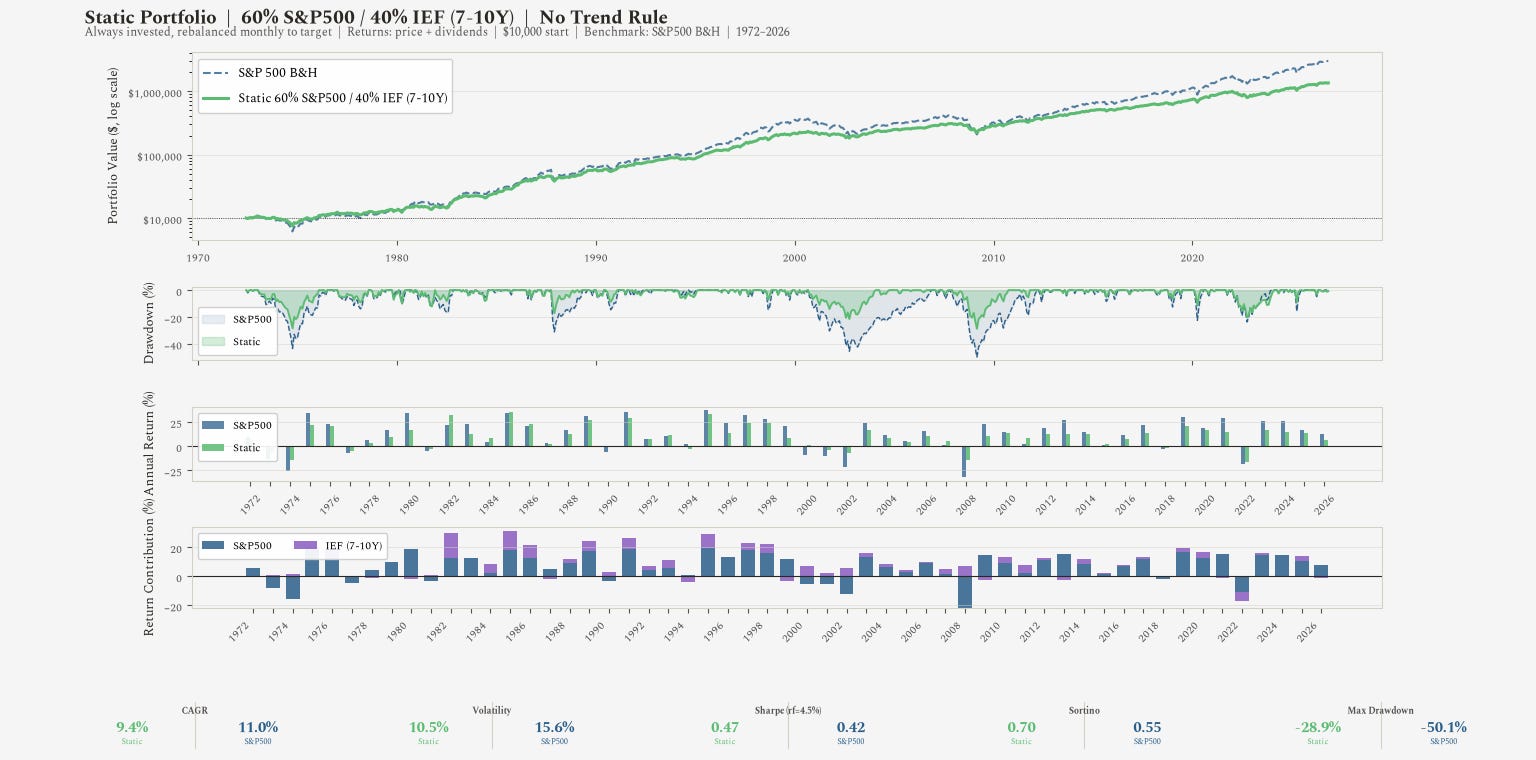
If you could ride out the downturns, just holding all stocks is better over the long run. The problem remains that you don’t want to lose 50% of your money right before retirement, or in general.
The Rule
I use technical analysis quite a bit, and the simplest tool is the moving average, which is merely the average price of the last number of weeks. Moving averages often act as support and resistance levels for price and can be a barometer of things like momentum and trends. The 12-month simple moving average (SMA) is also the 52-week SMA and 250-day SMA. This is a slow and lagging indicator that can be used to avoid major drawdowns.
The strategy is this: when price is above the 12m SMA and out of the market when price is below the 12mo SMA, hold money market/short term t-bills when in cash.
This extremely simple strategy can avoid most of the losses associated with bear markets. You won’t pick the top or buy the lows, but that’s not the point, and is very difficult anyway. Backtesting this strategy to 1972 shows a nearly identical CAGR of 11%. The volatility goes from 15.6%→11.4%, max drawdown from 50.1%→23%, and improves the risk-adjusted return (sharpe/sortino).
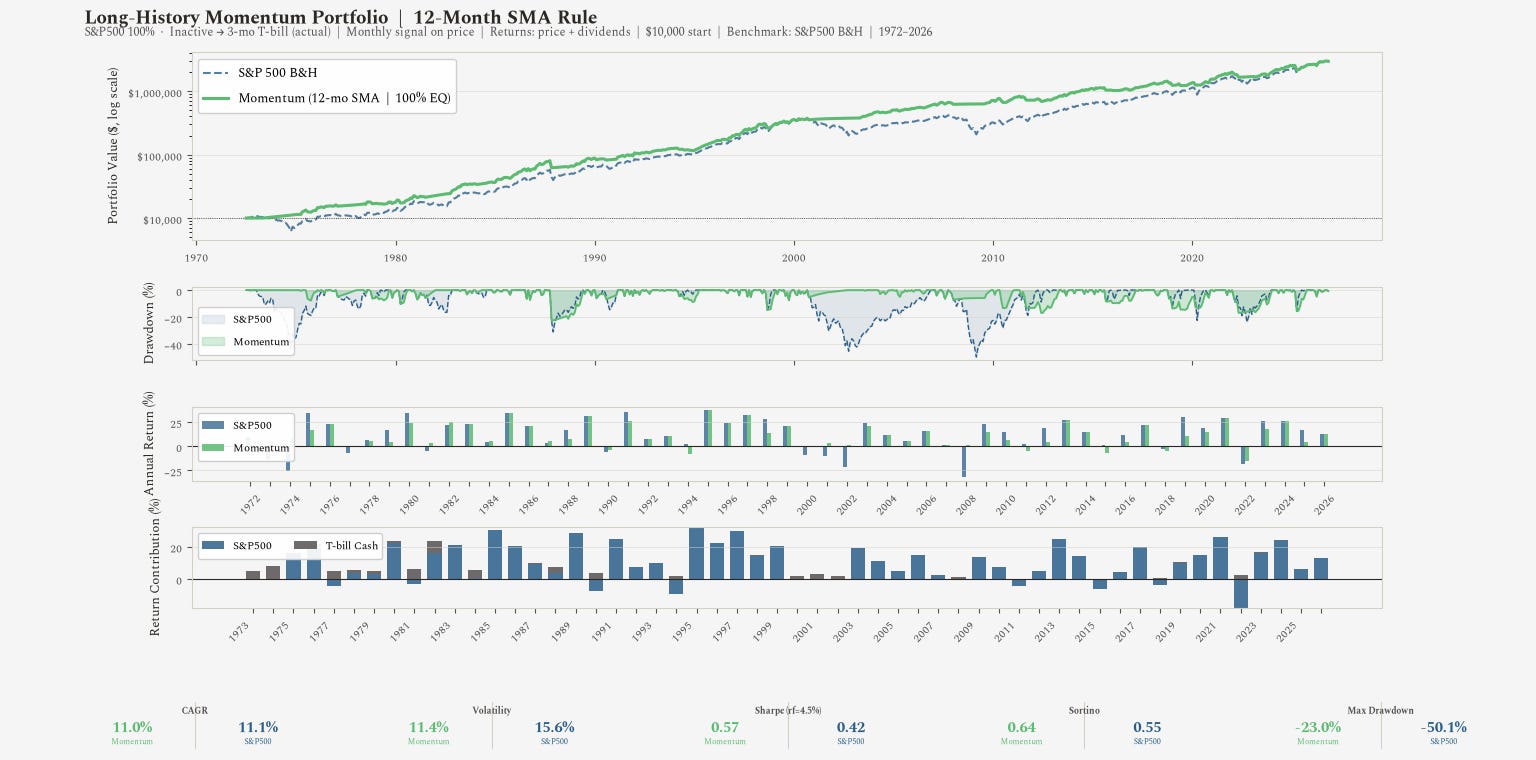
Apply the same rule to the 60/40 portfolio, and you get the same CAGR as the static 60/40 backtest, but with even better risk-adjusted returns, volatility, and max drawdown. Now that we have established the risks of major losses in a portfolio, the importance of diversification, and the power of an extremely simple technical analysis approach to investing, the fun can begin.
At The Gray Area, we believe the future macroeconomic environment is likely different from the one we are in now, meaning the assets that do well may not do as well. Stocks and bonds alone don’t provide adequate diversification depending on what period we are in. 2022 and the 1970s are prime examples. To find out the methods of TRUE diversification and risk management while still beating the market, check out the Model Portfolio (click here).
The Simple Strategy
The point of this exercise is to make things incredibly simple. This new portfolio will be a small addition to the monthly Model Portfolio updates. Instead of ~10 positions actively managed, it has only 3 and is rules-based, using the extremely simple rule I established above. While you can get most of the way there with the simple S&P 500 strategy I outlined above, paid members will get access to the simple 3-asset strategy here, tracked monthly, that beats the market significantly with better risk-adjusted returns and lower drawdowns over the backtest.
Like to see these asymmetric opportunities synthesized into a real model portfolio that beats the S&P 500 and avoids major downside risks?