

If you find this article interesting, click the like button for me! I would greatly appreciate it :)
The Story
Behind every good bubble/mania is a story that captivates investors and fuels greed so strongly that it becomes the dominant narrative. From mainstream media to uninformed family members, the story becomes an unescapable zeitgeist. The first question becomes whether it was grounded in technological revolution or it was an old-fashioned psychological mania (1630s Tulip Mania).
I’ve written in some detail about the US railway mania in the 1870s, which makes the topic of this piece even funnier, because it already happened in Britain 30 years earlier.
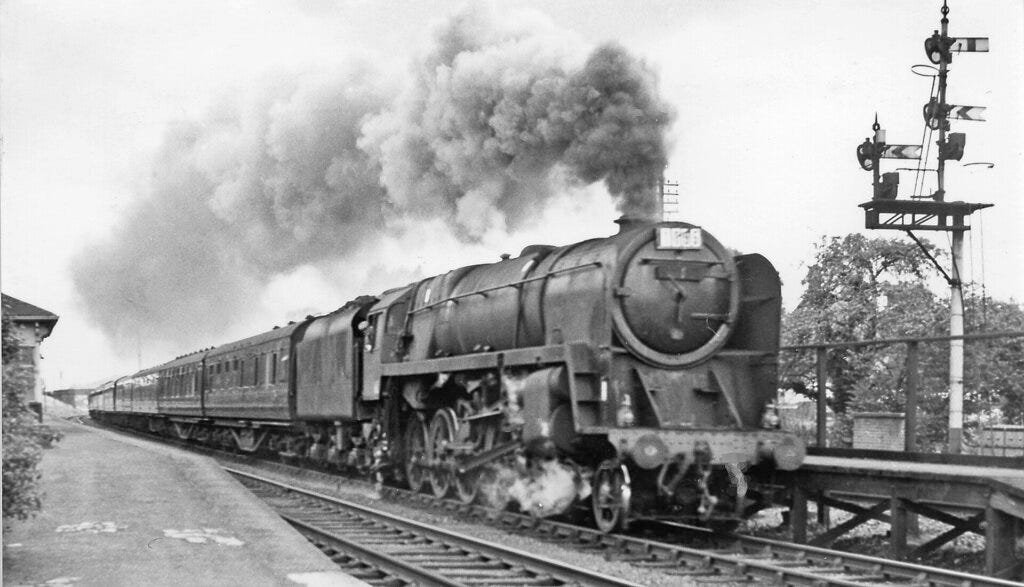
In 1830, the Liverpool & Manchester Railway opened as the first passenger line built specifically for steam locomotives. Despite the showcase resulting in the first passenger railway casualty, it worked properly and was profitable almost immediately. The story was formed, and it was a real technology with real profitability.
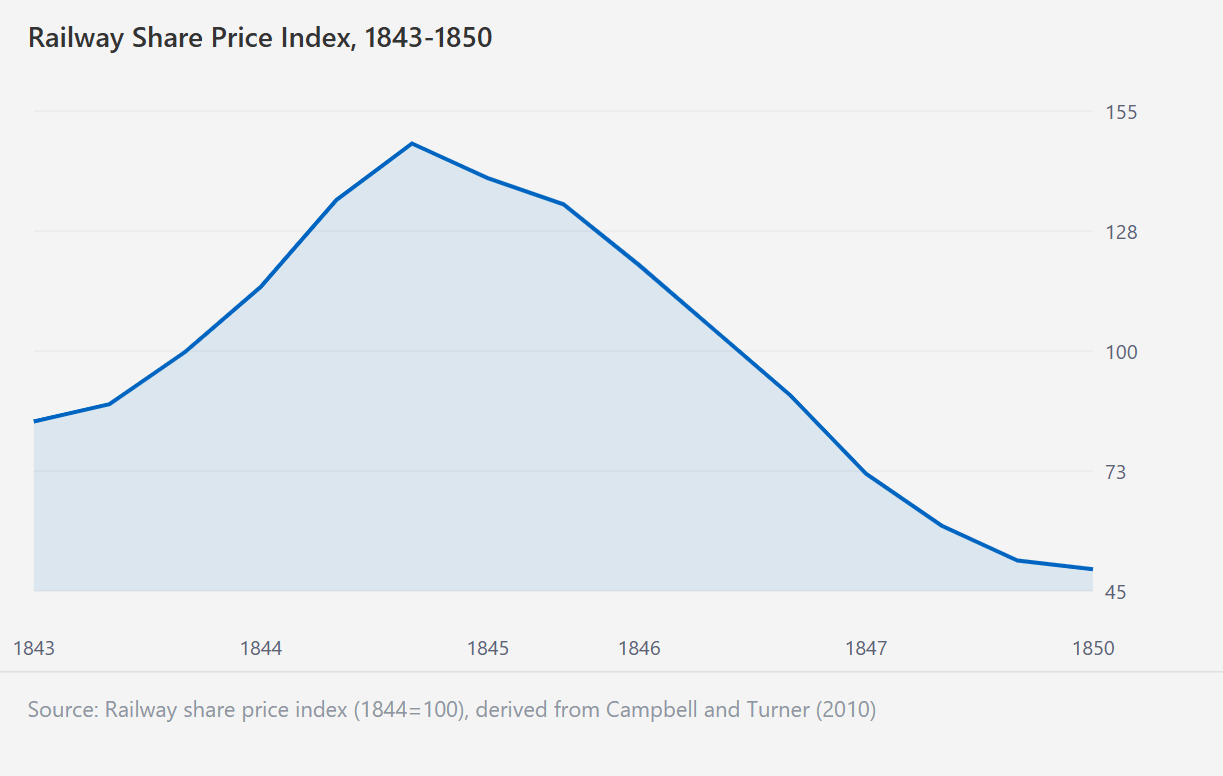
A weak economy followed the Panic of 1837 in Britain. As a result, interest rates were low, and capital financing was cheap for early railroad companies, boosting profitability. As people saw the success, railway securities on the London exchange roughly tripled between 1843 and 1845. Speculation in railroad stocks followed alongside the number of new entrants into the market.
The Speculation
Even if the story is correct, investments can still go horribly wrong. In this case, railroads were a key economic revolution. It created jobs, increased productivity, and
On top of cheap financing costs, speculation fueled 10% deposits for investments. It was customary at the time for infrastructure investments to call upon investors at each stage of construction rather than all up front. This expanded the investor base dramatically. Common folk were able to join in on the party instead of merely the upper class, even if they weren’t thinking about the total cost of their commitment.
Laws at the time allowed fast-tracked company formation and the ability to raise money without any previous infrastructure. Newly started companies also ran aggressive marketing campaigns in newspapers, sometimes with grandiose claims and often suspicious accounting methods. The first modern audit was not performed until 1949, after the mania fell apart. In 1845, over 1,200 railway schemes sought Parliamentary authorization. Many competed for the same routes or were outright shells with no serious intention of laying track.
Like any good mania, it had its fraudsters. George Hudson became known as The Railway King. Long before Ponzi made his rounds around North America, Hudson used dividends paid out of capital rather than earnings to manufacture the appearance of profitability and attract new investors. Companies like Hudson’s were fraudulent and eventually succumbed to burdensome debt refinancing.
The Bust
The story of the railroads doesn’t mean it is going to end in chaos, but the speculation does. While some companies had solid moats and profitability, the companies that took too much leverage, laid duplicate tracks, or raised money without physical infrastructure under the mania were malinvestments. Any real economic weakness would show where the cracks were.
Real economic headwinds did soon follow. Crop failures increased imports and prices for consumers, while gold left the country. Interest rates increased, enticing capital to bonds over railroad equities on the margin. On the consumer side, calls for the next round of financing (the rest of the promised 10% deposited) were a heavy burden. On the commercial side, railway-linked non-bank lenders, corn-trade speculators, a famine-driven gold drain, and higher interest rates caused deteriorating liquidity conditions.
As debt refinancing burdens rose, many companies could no longer hold out. The speculative credit had run its course. By 1850, railway share prices lost roughly two-thirds of their value from the peak in 1844.
conclusion
The British railroad mania and the story told were real and transformative. It laid the tracks that would power transportation of passengers and freight for decades to come. That didn’t stop the industry from losing 67% and hundreds of companies from being wiped out. The lesson is recognizing if the story has transcended into unsustainable mania and how to avoid losing money.
This is similar to the current AI bubble. It has a grounding in a transformative new technology with a story sparking a wave of new investment. The investment is in the process of becoming too speculative and burdensome, just like the British railroads.
The AI investment is already running at extreme levels of the entire economy (1.4% of GDP, 3.1% by 2030). These are bubble territory despite not being rookie numbers compared to the 7% of the British railway mania.
We can also compare the new investment share of economic growth rather than compared to the size of the entire existing economy. Railway investment consumed roughly half of all investment happening in Britain at the mania’s peak. Those are rookie numbers compared to today, where AI investment is the only thing holding up the economy. 74% of Q1 2026 GDP growth was attributed to AI investments.
The British bubble walked into deteriorating credit and economic conditions as the catalyst for the collapse. Deteriorating consumer health, rising interest rates and thus refinancing costs, tighter credit conditions, and increased debt are all similar to today’s AI mania.
History doesn’t repeat, but it often rhymes. Are you willing to learn from them and not let your capital become the collateral damage that loses 67% or more? Subscribe to the Model Portfolio to learn how. Until next week,
-Grayson
Like to see these asymmetric opportunities synthesized into a real model portfolio that beats the S&P 500 and avoids major downside risks?
Socials
Twitter/X - @graysonhoteling
Email - thegrayarea55@gmail.com
Archive - The Gray Area
Notes - The Gray Area
Promotions
Sign up for TradingView
For educational and entertainment purposes only. The Gray Area should not be taken as financial advice.