

If you find this article interesting, click the like button for me! I would greatly appreciate it :)
What if I told you that predicting the future was possible? Maybe not who will win the World Series, or what Nvidia’s stock price will be 1 year from now, but how generational moods change politics, economics, and institutions. This is the idea behind the Strauss-Howe generational theory, which I’ve discussed in Your Turn.
The framework suggests that high times and chaos times are cyclical and predictable. The fourth turning is where major crises and changes happen. Institutions are inadequate and destroyed, and new ones take their place. We are in a fourth turning now, according to the authors, precipitated by the 2008 financial crisis. Since we are in the “chaos” times, it is useful to understand the previous cycles and how we might protect ourselves from the negative events they were wrought with.
I’ve discussed the recent fourth turning during the great depression/WWII. The period of unraveling and the causes of the Great Depression are debated historically, as I discuss in my piece, Great Depression. Then, I discussed what happened politically and economically in the fourth turning and how to protect your wealth in such a time in Tumultuous Times. These are useful connections that are worth reading for their prescience today, but not necessary for understanding this piece about the Civil War period.
Prewar
The American Civil War period is canonized in textbooks by a heroic Abraham Lincoln taking it to greedy Southern elites unwilling to relinquish slavery. The truth is, unfortunately, far from this. Emancipation was used as a political tool rather than the primary moral grounds for the Civil War. Lincoln’s original inaugural address in 1861 expresses this as such. He vows not to interfere with the institution of slavery, but has every intention to uphold the economic arrangements of the time.
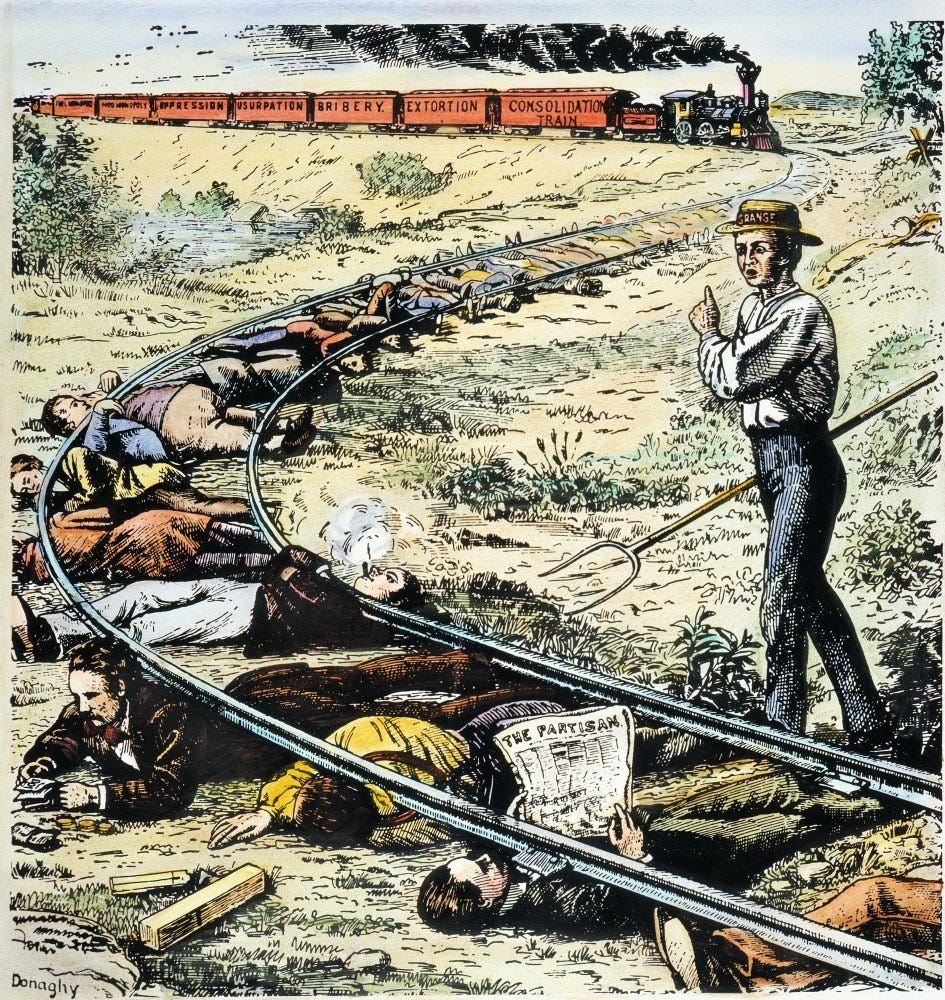
These economic arrangements were the real powder keg for the Civil War, not slavery (perhaps already approaching economic inadequacy). The prewar period was essentially one big wealth transfer system that was reaching a breaking point. The primary economic engine was the agricultural industry of the South. The mechanism at the time was tariffs, which were paid by the South and generated revenue for the Union in the North, only further exacerbated by the aggressive increase in the Morrill Tariff Act of 1861. Revenue generated in the South was used to subsidize railroads, big banks (like Jay Cooke, who helped finance the war effort), and the northern industrial economy.
The political elites knew the economic consequences of secession; without upholding tariffs in the South, Northern imports would also reroute into Southern ports, destroying the Northern economy. In the July 4th message to Congress, Lincoln admitted that the resupply to Fort Sumter was an intentional provocation for the South to fire the first shots and give a pretext for war.
"If I could save the Union without freeing any slave, I would do it; and if I could save it by freeing all the slaves, I would do it; and if I could save it by freeing some and leaving others alone, I would also do that." - Lincoln, Greely Letter Aug 2, 1862
Reconstruction
The strongest evidence of war motives wasn’t even Lincoln’s quotes, but the Reconstruction following the war. Reconstruction turned out to be a massive failure, as troops remained across the South to enforce policies. With a contentious election, the Compromise of 1877 was passed, which gave Rutherford Hayes the presidency in exchange for withdrawing federal troops from the South.
Reconstruction attempted to give freed men land, access to capital, and political power. Unfortunately, land was often reconquered by the prewar elite slaveowner class. The Freedman’s Savings Bank was looted by the Cooke family, the same financial elites that dominated before the war and funded it. Political and labor improvements were also not achieved in the new Jim Crow era.
The economic extraction mechanism was solidified by force, and the freedmen were abandoned after the war. The freedmen were useful as a political tool during and disposable once the fiscal architecture was secured.
A first turning starts when new civics emerge, and people rally behind new institutions. This was hardly the case, as the corrupt institutions were merely upheld by the Civil War and Reconstruction. Strauss and Howe officially acknowledge that the Civil War period was weird, and the fourth turning was much shorter than the typical generational cycle. I argue a different case.
Banking
Alongside the failed reconstruction, the underlying economic and institutional questions that produced the crisis were still unresolved following the crisis. Long before the war, the Second National Bank was dissolved by Andrew Jackson. While this could be considered a free market miracle by government standards, the void it left was no better. Rogue regional banks were left decentralized and unregulated to use fractional reserves to their advantage, with no standardized collateral. This increased credit and speculation contributed to bubbles in Western land expansion and railroads.
The banking system had doubled in size, and railroads were heavily subsidized (powered by the agricultural revenue engine of the South). This inevitably came to a halt in 1857 when the credit bubbles collapsed. Telegraph technology allowed this to be the first nationally transmitted financial crisis. Bank failures, bankruptcies, and railroad stock crashes ensued.
The financial system wasn’t necessarily in a robust position heading into the Civil War. Jay Cooke, a politically connected banker, worked with the Treasury to issue bonds to fund the war. Instead of merely working with smaller banks, he marketed directly to citizens around the nation, a novel concept. Then, he lobbied and helped design the National Banking Acts, which forced banks to hold federal bonds to issue their own bank notes. This centralized control of the banking industry and connected federal debt issuance with private credit expansion more than ever.
Simultaneously, the government undertook the most extreme fiat currency experiment, with the issuance of greenbacks as legal tender. Combined with the suspension of gold convertibility, this naturally led to immense inflation and debt devaluation, all to fund the war effort.
Fourth Turning Continues
Once the war financing ended, the infiltration of bankers and the federal government did not subside (unsurprisingly). Cooke and Company turned to the railroads again, issuing loans to railroad companies alongside heavy government subsidies. At the same time, the government had to use productive capital to pay war debts. This became problematic as the bank’s ability to lend was based on treasury bond collateral, which was decreasing, let alone increasing at the rate required for the railroad speculation.
The chickens came home to roost as fears of overcapacity, cost overruns, and the Crédit Mobilier corruption scandal depressed Northern Pacific bond prices in 1873. Cooke and many others went bankrupt. The government-subsidized credit expansion led to absurd levels of malinvestment, which then led to one of the worst economic depressions in American history, the Panic of 1873. The depression that followed lasted roughly six years, had record unemployment, and was known as the Great Depression until the 1930s.
The depression was also hampered by the Coinage Act of 1873. This launched a de facto gold standard by cutting the role of new silver as a legal tender. Ironically praised by sound money folks and big bankers alike, it reduced the ability of inflationary monetary policies. For the surviving big banks, the strengthening dollar without government issuance of greenbacks and new silver meant that value was transferred from the debtor to the creditors. A farmer who takes on debt in an inflationary regime pays back the loan with worthless dollars. Now, the farmer all of a sudden has to pay back debts in dollars worth much more. This brought even more financial hardship to debtors around the country and contributed to a rising populist movement for more inflationary policies later in the late 1800s.
The bankruptcy of Jay Cooke was the symbolic destruction of the war’s financial apparatus, but the Compromise of 1877 and resumption of gold convertibility in 1879 were the institutional capitulations that allowed the new era to be ushered in.
The war ended secession as a live option in 1865, but the actual subordination of state power to federal power was a legislative and judicial project that continued for decades. The 13th, 14th, and 15th amendments fundamentally altered the power balance between federal and states, leading to multitudes of future legal battles like Munn v. Illinois in 1877, serving as an inflection point for future Supreme Court cases.
The genuine resolution came by 1877–1879. The political compromise ended the military occupation and restored domestic governance to the South. The monetary resumption of the gold standard settled the currency question. The new constitutional grounds were set by the new amendments. The railroad collapse cleared the speculative excess and left a real infrastructure. These were the terms on which the postwar order was actually accepted, and they are less flattering to the moral narrative of the war than the mainstream version.
The time that followed was known as the Gilded Age, sharing more qualities with the “high” period in the generational theory framework. Real wages increased, economic growth was strong, many legendary companies were created, and innovations were made.
Conclusion
Instead of a short fourth turning and a strange first turning, I propose an alternative where the Civil War wasn’t the end of the fourth turning, and instead the 1st turning was shortened. A “high” doesn’t contain a failed reconstruction, the railroad bubble, the Panic of 1873, or the Great Depression of the 1870s. This sounds more like a 4th turning. To me, it appears that the political and economic institutions that were fought so desperately for during the Civil War and after were finally destroyed and rebuilt by 1979, not 1965. This is when the new civic compact started, and the next cycle began. This takes a more monetary view on things rather than the social moods that Strauss and Howe view as foundational, but it fits better in my eyes.
Unfortunately, the Civil War was about the political class trying to uphold their political and economic interests by force, rather than a moral imperative to free the slaves, as proven in hindsight by Lincoln’s prerogatives and the Reconstruction failure. The end of the Civil War did not usher in the next phase, but merely secured the same system. It wasn’t until the collapse of that monetary system and eventual political compromise that the next cycle with new institutions could be ushered in.
We should take from these analyses of the fourth turnings that the existing order will fight tooth and nail to protect its political and economic interests, whether a Civil War or a world war.
This typically involves rapid monetary change and government intervention. Debasement of the currency and the withdrawal of gold convertibility are recurring themes with massive economic impacts.
It also means institutions change. Perhaps not for the better in the long run, but at least providing some stability. Political agreements between the two parties were found, the banking industry found a new footing intertwined with the federal government, and newly freed men were left to find a new path on their own. Until next time,
-Grayson
Like to see these asymmetric opportunities synthesized into a real model portfolio that beats the S&P 500 and avoids major downside risks?
Socials
Twitter/X - @graysonhoteling
Email - thegrayarea55@gmail.com
Archive - The Gray Area
Notes - The Gray Area
Promotions
Sign up for TradingView
For educational and entertainment purposes only. The Gray Area should not be taken as financial advice.