

If you find this article interesting, click the like button for me! I would greatly appreciate it :)
History does not repeat, but often rhymes. In a previous piece, Your Turn, I laid out the Strauss-Howe generational theory and its four turnings: the High, the Awakening, the Unraveling, and the Crisis. Each turning lasts roughly twenty years, with the full cycle about a human life. The generations that remember the last crisis age out, institutions grow complacent, and the conditions for the next one quietly reassemble.
The last Fourth Turning (crisis phase) ran from roughly 1929 through 1945. It opened with the stock market crash, deepened through a decade of depression, and climaxed in a global war that killed tens of millions. On the other side was the 1st Turning High: the postwar boom, strong institutions, rising middle class, record household formation. Think of the analogy: hard times create tough men, tough men create good times, etc.
According to Howe, we entered the current Fourth Turning with the 2008 financial crisis, but haven’t reached the climax yet. Whether that is a war, depression, civil crisis, or revolution remains unknown, but we can study the last ones closely. This isn’t the watered-down high school textbook, but what happened to your money, what the government did to it, and what survived if you were there.
Great Depression
If you Google the 1929 stock market crash, you will get told it was rampant speculation in stocks that cascaded into a collapse in debt. While true, this ignores the real cause of it all. The Federal Reserve was established in 1913, which conveniently helped the US fund its entrance into WWI the next year. Alas, the central bank was engaging in easy monetary policy. The government subsidized credit expansion to an unprecedented scale, which led to the roaring 20s and the bubble.
Similar to 2000, and what will happen at some point in the near future, the bubble popped and credit defaults soared. Stocks collapsed and banks failed, similar to 2008. Deflation caused demand destruction and many businesses and farmers went out of business, as well as unemployment soaring higher. The economic depression lasted over a decade until the US entered WWII in 1941.
Mainstream economics tells us that Hoover’s Laissez-faire policies made the depression last for so long, and it wasn’t until FDR’s stimulative New Deal policies that the recovery started. This couldn’t have been further from the reality as I discuss in detail in Great Depression (drawing from key insights from one of my favorite books, America’s Great Depression by Murray Rothbard). In reality, all of FDR’s interventionist policies had already been tried by Hoover to only prolong the hardship. The economic recovery did not occur under FDR, nor was it solved by sending millions of young Americans to die in WWII (hardly a better option).
Groundbreaking Policies
What we got were some of the most draconian and dystopian laws ever enacted in US history in the name of helping. Backed by the threat of force, FDR signed Executive Order 6102, confiscating gold reserves from US citizens. Gold was money and the backbone of the monetary system at the time, and comparable to the government stealing your assets or bank account. At least confiscating Russian bank reserves wasn’t YOUR money… They’ve done it before. Gold redeemability was closed and the stolen gold was revalued 66% higher. This is an important lesson that in a fourth turning crisis, rules change and even private property rights can be violated by the very government claiming to be for them.
The next egregious policy was the Agricultural Adjustment Act of 1933 is taught in most schools as one of the successful New Deal programs. The core mechanism of the AAA was supply destruction: the government paid farmers to reduce acreage and destroy existing output to prop up prices. In 1933 alone, approximately 6 million pigs were slaughtered and their carcasses discarded or turned into fertilizer. Cotton fields were plowed under. Corn was burned as fuel. This occurred while roughly one in four Americans was unemployed and widespread malnutrition was documented across rural regions.
The AAA was later deemed unconstitutional, which led an angry FDR to his infamous court packing scheme (similar rhetoric from Trump’s first term). This policy is a classic, unsuccessful, and honestly horrific government intervention, which laid the foundation for the distorted agriculture system we have today (ie, excess subsidies to corn and soybeans).
The Emergency Banking Act of 1933 also laid the foundation of what we all know and love about the banking system. This is the government bailing out banks, as seen in 2008 and 2022. It also involved the devaluation of US bank reserves to gold, which, of course, is not possible without confiscating private gold holdings.
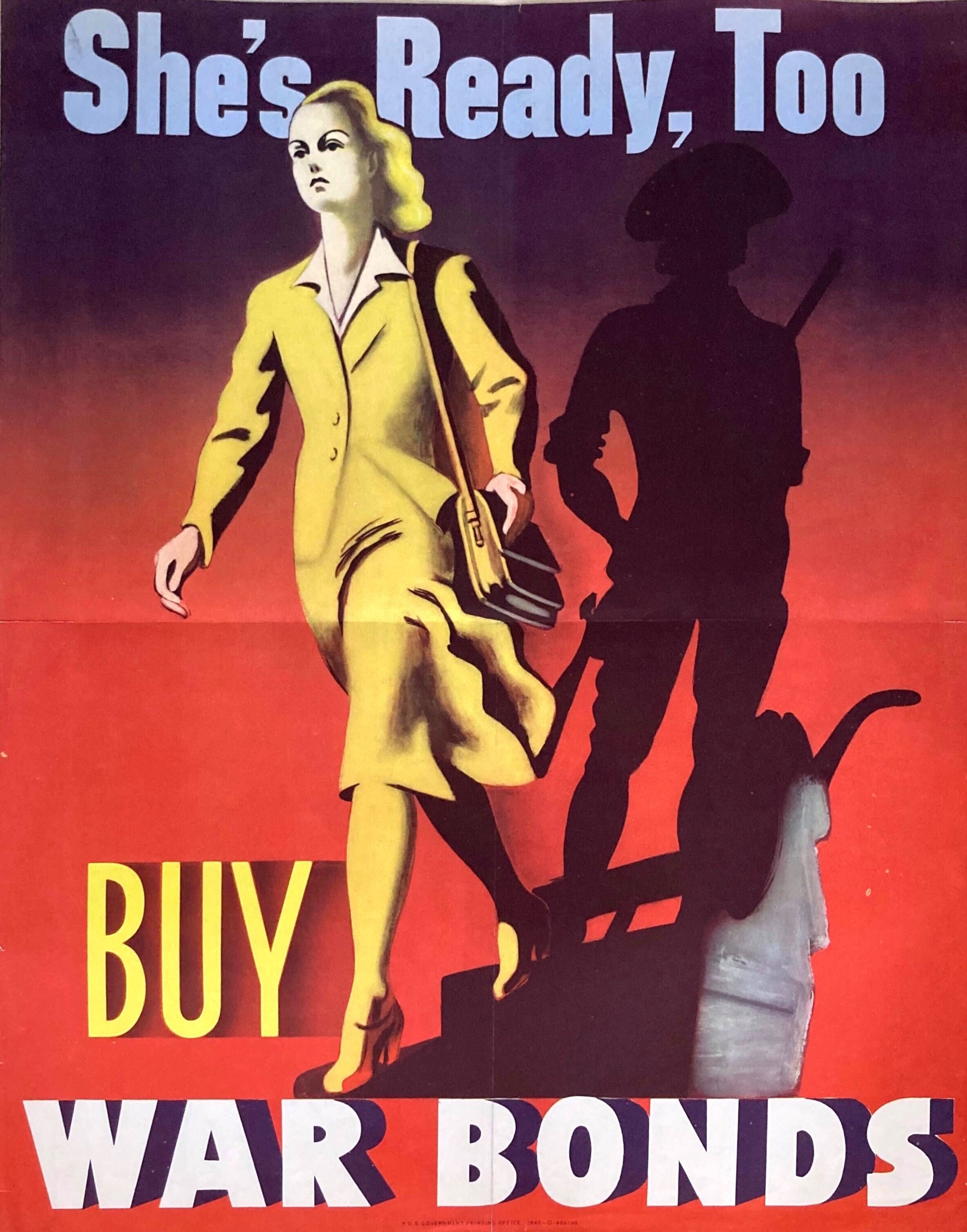
Then, during WWII, bond yields were pegged at 2.5%. With rampant inflation, this yield curve control/financial repression means that bondholders are financing US debts through devaluation. Along with the heavy War Bond propaganda machine, this was another way for the government to leave the citizens footing the bill (and the troops).
Rise of Populism
Despite what they say or their supposed best intentions, the government is not on your side in these crazy times. Like Trump today, FDR was a major populist president, successfully appealing to the economically distraught voter and placing the blame on the prior Hoover administration, despite only repeating the same and worse policies in office.
Check out my piece on populism, which is largely driven by wealth disparity and political polarization. Populism rises during fourth turnings, then and now, and can lead to some pretty bad leaders. Europe suffered an even worse fate during the 1930s, leading to the election of figures like Hitler, Stalin, and Mussolini, promising to usher in better times in their nationalistic interests. The problem is that many populist leaders merely use the voter anguish as a ploy to get elected and change once they get in power. War, rapid currency devaluation, genocide, and famine were all consequences of these elected leaders.
It is no surprise that some of the worst leaders came during these times, followed by some of the best on the other side, often war generals or those who transition into the first turning (high).
Whether it is stealing private property in the form of gold in 1933, bailing out banks at the taxpayer's expense in 2008, or being lied to and gaslighted during the pandemic, it is a time to have your eyes open and think critically. Hopefully, you understand that it is your job to control your financial destiny, despite the intentions of the governments, then and now.
Asset Performance
Most importantly, we can look at clues on how to secure your financial future, which will not be what governments and the mainstream suggest. Just last week, India asked its citizens to stop buying gold; surely they have the citizens in mind with that statement. By that skeptic logic, surely all the emphasis on putting money into index funds and 401k is a good option too…
Let’s look at the performance of major asset classes during the last fourth turning, seen in the figure below. Most know stocks had the worst performance in history, as the Dow Jones Industrial Average (DJIA) went down 89% in 1929, and down 50% again in 1937 after a few years of relief. Alongside the DJIA, agricultural commodities like Wheat performed horribly early on. Once the bottom was found, tactical allocations of these assets performed extraordinarily well.
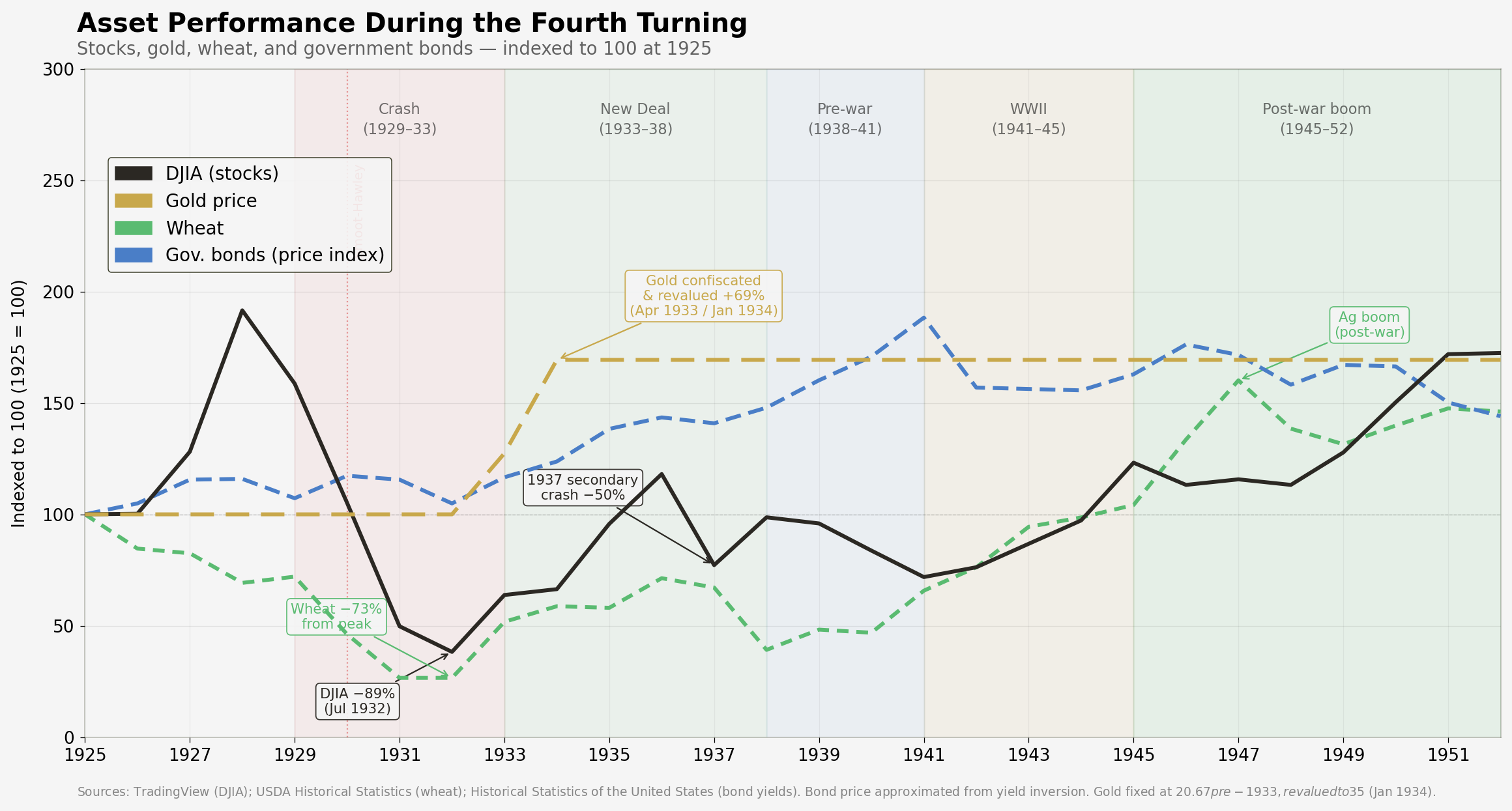
The importance of TRUE diversification cannot be understated during a fourth turning. An allocation to bonds showed positive returns in the early crash phase of the Great Depression. This is a similar story to 2008, when long bonds rose ~30% while the S&P500 crashed ~50%. Later on, bonds were used as a form of financial repression, yielding negative real returns, so it is important to aggressively ditch bonds after the initial protection.
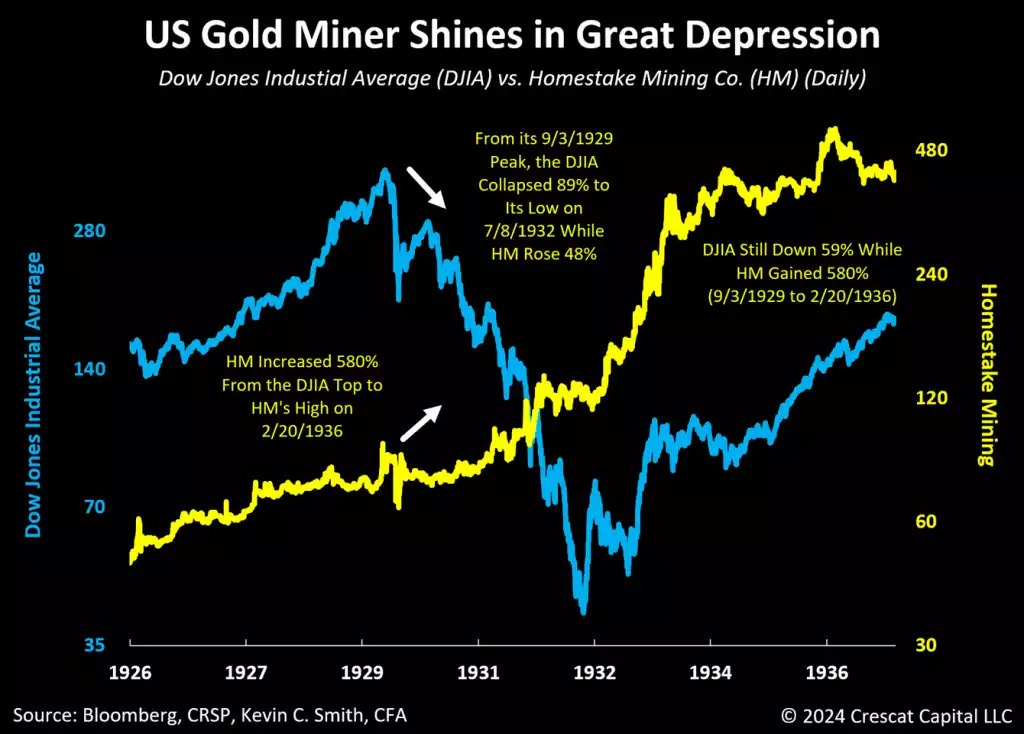
Gold would likely have been one of the best performing assets, but it was riddled with price controls and confiscation. It was revalued 66% higher in 1934 and was suppressed until 1971, when it exploded higher. Instead, it was confiscated and price controls capped the price at $35/oz. Gold mining stocks were harder to control. The top miners vastly outperformed during the initial depression as well as through the decade. Homestake Mining went up 580%, and stocks were crushed.
Implications
The Strauss-Howe generational theory has massive implications for today. If we assume a transformative event on the scale of the American Revolution, Civil War, Great Depression/WWII is underway, we should heed the warning and prepare. This isn’t merely fearmongering, as the signs are there: the 2008 Financial crisis, political protectionism, rise of populism, foreign conflicts, massive asset bubbles, etc.
We must be nimble, as the government will implement laws that change the status quo and lie about what the best course of action is. When the asset/credit bubbles pop, overweight bonds and underweight stocks may protect from the initial deflation from debt defaults. Then, as governments start enacting asinine economic policies, real assets like gold and gold/resource miners are critical. Tactical positions in things like agriculture also represent true diversification and asymmetric opportunity in fourth turnings.
Check out the model portfolio with a paid subscription to see these ideas synthesized into my actual portfolio, risk management, and rebalancing. I am not in a bunker and have been outperforming the S&P 500, but have real diversification like the themes discussed here.
-Grayson
Like to see these asymmetric opportunities synthesized into a real model portfolio that beats the S&P 500 and avoids major downside risks?
Socials
Twitter/X - @graysonhoteling
Email - thegrayarea55@gmail.com
Archive - The Gray Area
Notes - The Gray Area
Promotions
Sign up for TradingView
For educational and entertainment purposes only. The Gray Area should not be taken as financial advice.