

If you find this article interesting, click the like button for me! I would greatly appreciate it :)

Intro
A fourth turning is a period of chaos/transformation within the Strauss-Howe generational theory, which I neatly introduce in Your Turn. We are in a fourth turning now, which typically lasts ~20 years and is characterized by some of the most famous and transformative historical events (revolutions, wars, economic crisis, civil crisis). Our last fourth turning was the Great Depression/World War II time frame (GD/WWII), which I discuss in detail in Tumultuous Times. In it, I discuss the groundbreaking policies, rising populism, and, most importantly, asset performance over the period.
The gravity of ignorance heading into this period cannot be overstated. The Silent Generation is reaching the end of their lives, so most of us have not experienced this before. The markets have no lived experience investing in these times and are not tuned to these risks. Only by studying history can we truly prepare for what is to come. Investing has been easy, but all monetary and governance rules are thrown out the window during chaotic times. To find and study the fourth turning before the GD/WWII, we roll the clock back to the Civil War period.
Civil War
Most regard Abraham Lincoln as one of the best presidents in history, and are taught that the Civil War was taking it to the greedy Southerners unwilling to relinquish slavery. While there were greedy Southerners, Lincoln’s motives were unfortunately far from those of a moral savior.
I encourage you to read my full piece on the Civil War, as this is a mere summary. In short, the Northern elites knew the dire economic consequences of Southern secession. Heavy tariffs subsidized northern industry at the expense of the agricultural South, and the Civil War was pushed by Lincoln to protect the Union and this favorable scheme. Lincoln originally had no intention of ending slavery, and the Reconstruction era was proof that the slaves were a mere tool, rather than the prime directive.
Please read the full piece for my full argument, and why I believe the fourth turning didn’t end in 1865 with the war, but in 1879 when the new monetary and institutional order was finally settled.
Civil Policies
Political policies have huge implications for how to invest since some have to do with civil liberties, and others directly influence the monetary and fiscal regime. A good example that I discussed in Part 1 was when FDR signed Executive Order 6102 confiscating gold reserves from US citizens at a discounted value with the threat of prison or extreme fines. Not only does this violate simple property rights, but it also stole the primary method of saving for American citizens. Imagine the government shut off bank accounts, the primary method of savings today (happened already on a smaller scale in Canada in 2022).
The Emergency Banking Act of 1933, to bail out banks without requiring gold reserves, was not possible without the confiscation of gold first. Back to the Civil War, the Legal Tender Act of 1862 was passed so that a paper fiat currency could be created. Just like FDR, the monetary anchor was abandoned in the crisis period so that the government could print greenbacks to fund the war effort.
These periods tend to result in government overreach and an increasingly interventionist federal government. I discussed the Agricultural Adjustment Act of 1933; the Reconstruction period altered the constitutional framework of the United States forever. While the GD/WWII period was an attack on personal and corporate sovereignty by the federal state, the Civil War was an attack on state sovereignty by the federal state, with the Reconstruction legislation crossing the Rubicon for legislation granting federal intervention power into state affairs.
The war ended secession as a live option in 1865, but the actual subordination of state power to federal power was a legislative and judicial project that continued for decades. The 13th, 14th, and 15th amendments fundamentally altered the power balance between federal and states, leading to multitudes of future legal battles like Munn v. Illinois in 1877, serving as an inflection point for future Supreme Court cases. - The Gray Area
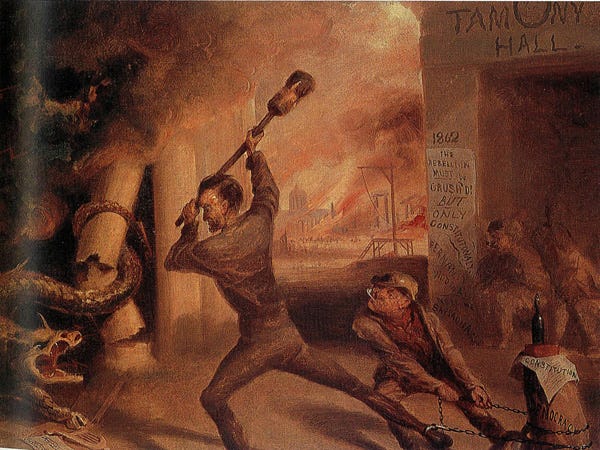
Lincoln also suspended habeas corpus in 1862 to suppress opposition without due process and protection from the Constitution, which was then legally ratified as a federal power in the Habeas Corpus Suspension Act of 1863. This gave the federal government immense power to ignore First Amendment rights and increase power over states.
Economic Policies
National Banking Acts created the first federally chartered banking system. Each bank with a charter was required to hold U.S. Treasury bonds. This, along with the issuance of new currency, was a move to fund the war through devaluation efforts. Jay Cooke, a politically connected banker, worked with the Treasury to issue bonds to fund the war. Instead of merely working with smaller banks, he marketed directly to citizens around the nation, a novel concept. This was a tactic similarly used in WWII with war bond propaganda.
Both permanently tied the banking system's health to government debt and government backstops in ways that didn't exist before the crisis. Both instituted financial repression as a tactic deemed necessary under the emergencies of the time.
As I argued in The Civil War, the fourth turning didn’t end at the war’s conclusion, but as the monetary order was finally reshaped in the decade that followed. All of that financial repression actually benefits debtors as the value of debts is inflated away by new money being worth less than old money. Back then, there were still strong political movements that supported hard money (gold/silver), but truthfully, it was the banks that wanted to return to hard money. At this time, large banks wanted to preserve their standing, especially over the smaller banks. The best way to do this was to return to the gold standard. They achieved this politically with the Coinage Act of 1873, which made a gold standard by default.
It took a long time for the banking cabal to get so corrupt that they could just get instant liquidity from the Federal Reserve (next fourth turning). In this period, the resumption of the gold standard actually drastically strengthened the dollar and was the opposite of the wild money printing. While I am a supporter of having a currency tied to real fiscal constraint, it clearly is discarded during fourth turnings. Further, these wild swings ended up strengthening big banks at the expense of smaller banks working with silver, and more importantly, severely impaired low/middle class workers who had debts. All of a sudden, their debts had to be repaid in dollars worth more than before, destroying the financial well-being of many with outstanding debts. Wealth was transferred from debtors to creditors, the opposite of the GD/WWII era where financial repression continued throughout the fourth turning.
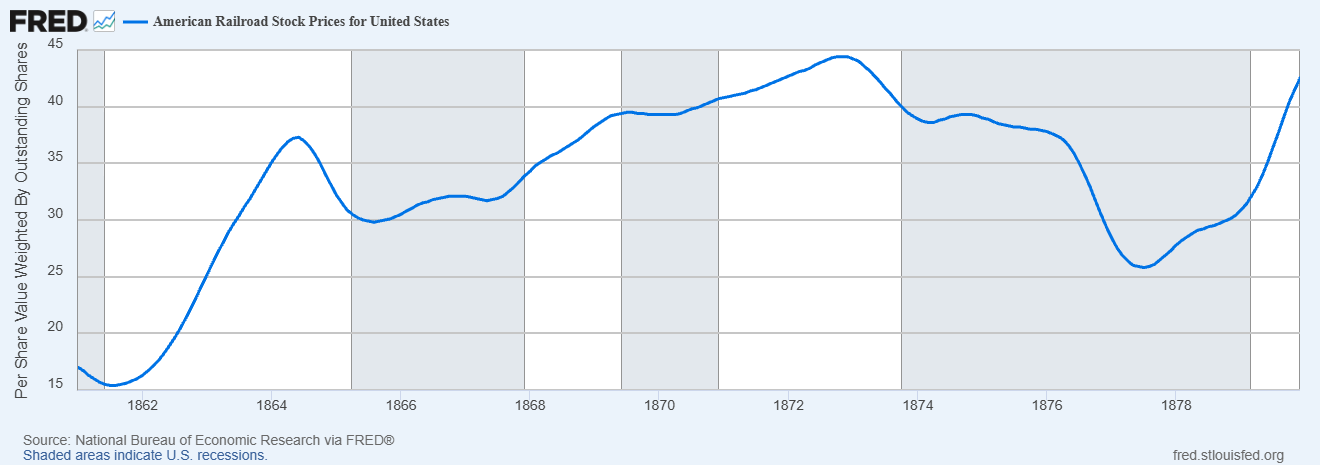
A defining feature of the pre and post Civil War era was the financial bubbles in railroads and western land expansion. The North’s financial health was not in the best shape heading into the Civil War, following the Panic of 1857, which contributed to some of the more radical monetary/fiscal policies. This didn’t stop railroads from bubbling again afterwards, leading to yet another Panic in 1873. This one wiped out Cooke, one of the key players in cahoots with the new federally involved banking industry. He and many others in the revolutionary railroad industry were destroyed. It was known as the great depression until the next fourth turning, and what is now known as the great depression of the 1930s.
Asset Performance
Asset performance is the meat on the bones. History is important because during fourth turnings, it rhymes in eerie ways and gives clues about what radical political moves get made that most people won’t see coming. These are always born out in prices of assets, especially those that hold value like commodities.
During the mid to late 1800s, there wasn’t a broad, liquid, and diversified stock market like there was by the 1920s. During this period, wealth was tied up in government bonds, railroad bonds, bank deposits (cash), and precious metals.
Equities were almost all in the booming railroad sector, and most in railroad bonds. Equities crashed in two waves over this period. First in 1857, then after a recovery and continuation of the epic railroad bubble, a crash in 1873. Historians estimate a ~50% corporate default rate during the period, the highest ever, along with equities crashing ~70%. This false rebound behavior is a common phenomenon seen between 1929 and 1937, but also in recent memory between 2000 and 2008. In technical analysis, this is the corrective b-wave before the c-wave in a simple abc correction.
Most people held wealth in land, physical coins, and bank deposits in urban areas. Things were wild as there was no deposit insurance and the Federal Reserve. In panics, banks went under, bank notes/deposits went unpaid, and bank runs were common. Land was only a good investment if unleveraged, as debtors were crushed after the Civil War with the resumption of the gold standard. Luckily, they wouldn’t get their gold stolen like their grandchildren in the 1930s, so what hard currency they did have would hold up reasonably well.
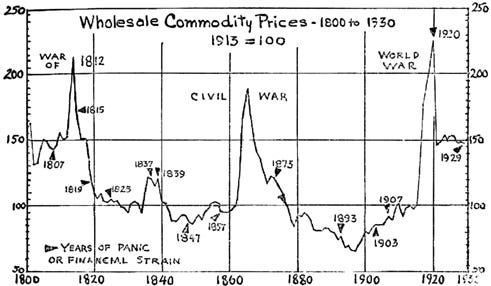
Agricultural commodities served well in inflation-adjusted terms initially. This was short-lived as wheat and cotton in the South were subject to heavy wartime blockades. Deflation then gripped the industry after the war ended as well. Livestock, iron, coal, timber, and soon-to-be oil were other commodities that were highly volatile at the time.
Precious metals were abandoned during the crisis. Luckily, they weren’t confiscated this time, so if you had any wealth, you were protected from the wartime financial repression. After the resumption began, the value of gold relative to the dollar actually went back down, but it remained a fundamental asset as the currency and what backed bank balance sheets. Gold mining stocks did not exist yet, but gold remained the most important commodity during and after this period.
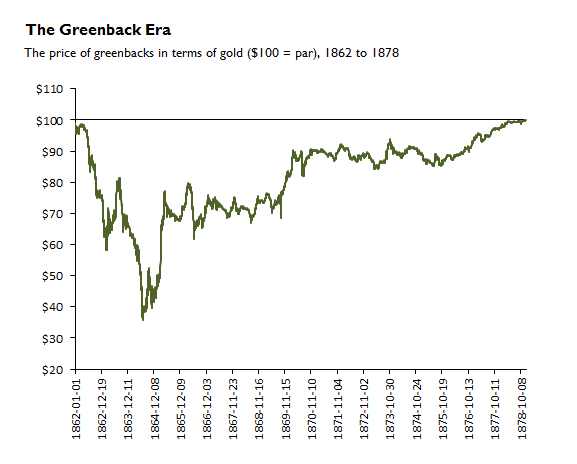
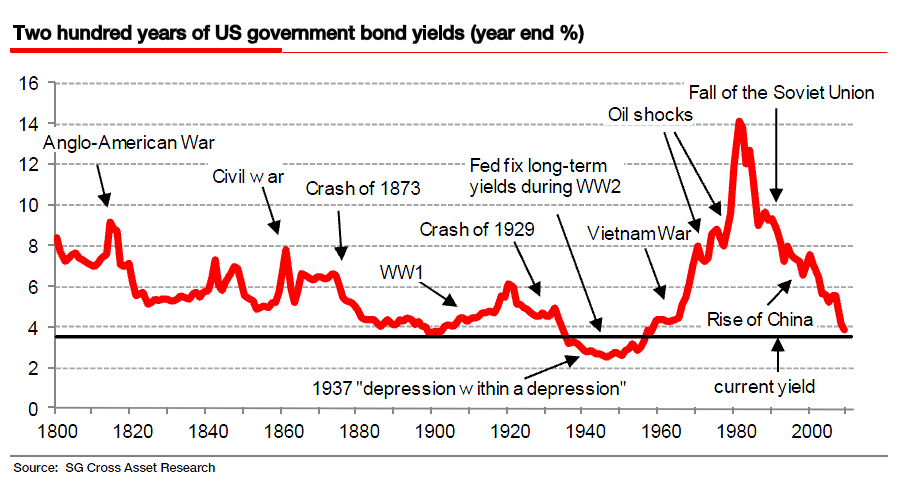
While railroad bonds were the worst investment, government bonds were the best. First, the bonds issued at the time were purchased with greenbacks, but paid interest tied to gold, meaning interest payments were very attractive. Then, by the time that many bonds had matured, resumption meant that the underlying currency of the bond was appreciating since you bought it. Third, after the war ended, bond yields tracked lower as inflation/growth slowed, giving capital appreciation on bond prices. Fourth, the Panic of 1873 meant a flight to safety into government bonds from other assets, giving more price appreciation.
Implications
The wealth transfer was different in the 1870s and 1930s. The Civil War gold standard resumption left anyone with leveraged real estate or debt destroyed. Conversely, the GD/WWII era yield curve control/financial repression hurt creditors and helped devalue government debts. Today, our banks intertwined with the government don’t have any incentive to support creditors explicitly since the Federal Reserve exists to bail them out if liquidity dries up and the gold standard no longer exists. Financial repression is the likely path today, meaning real assets and devaluing debts are good investments.
Gold is an escape valve. Coins and physical currency did not devalue as much as greenbacks in the Civil War, and gold mining stocks served you well during the GD/WWII since gold was confiscated. Today, gold will help hedge monetary inflation once governments begin massive liquidity creation again.
Equity bubbles do not last in fourth turnings. Railroads during the 1870s and equities in the 1920s were massive bubbles leading to the two biggest collapses in American financial history. This means that today is on the same scale as railroads and 1929 rather than the dot-com, nifty-fifty, or 2008 real estate.
Bonds were the protection in the panics. The Civil War period was uniquely positive for government bonds through the fourth turning. Bonds appreciated during the crash phase in the GD/WWII period, but were subsequently horrible during the financial repression period. Today is likely to be closer to the latter. There are no hard money politicians or incentives left, only continued monetary irresponsibility. Bonds can hedge crash risk, but are most likely a terrible long-term investment.
The importance of being smart and nimble during a fourth turning is clear. The government and big banks will change the rules. In the Civil War, debtors do really well initially, then policy shifts and creditors end up the real winners. Severe inflation preceded severe deflation. Mega bubbles in equities were a defining characteristic alongside a massive debt crash and economic depression.
Both Fourth Turnings prove the government will suspend, redefine, or seize control of money and property under crisis pressure, but the wealth transfer differed. The lessons aren’t always to own gold, or always own bonds, but to identify the direction the wealth is heading. It is more important than ever to have financial understanding, critical thinking, and the ability to be nimble with your assets.
If this is something you might need examples of, consider upgrading to see the Gray Area Model Portfolio. Instead of throwing all our money in the S&P 500, a bubble ready to be destroyed like equities in 1873 and 1929, we have real diversification to the fourth turning risks. In addition, we show superior risk-adjusted returns and how to do risk management and technical analysis.
Until next week,
-Grayson
Like to see these asymmetric opportunities synthesized into a real model portfolio that beats the S&P 500 and avoids major downside risks?
Socials
Twitter/X - @graysonhoteling
Email - thegrayarea55@gmail.com
Archive - The Gray Area
Notes - The Gray Area
Promotions
Sign up for TradingView
For educational and entertainment purposes only. The Gray Area should not be taken as financial advice.
Wow, excellent!