

If you find this article interesting, click the like button for me! I would greatly appreciate it :)

In episode 342 on why price controls don’t work, I introduce you to the data center. The AI mania has caused the largest companies to spend all their money on building data centers to support new compute efforts. Data centers consume a lot of electricity, so the grid is once again an exciting thing to talk about.
The PJM interconnection, serving the mid-Atlantic region, is the largest regional grid operator. The regional power operator has found itself with an interconnection queue of over 8 years. This means that new power generation wants to come online, but is having difficulty.
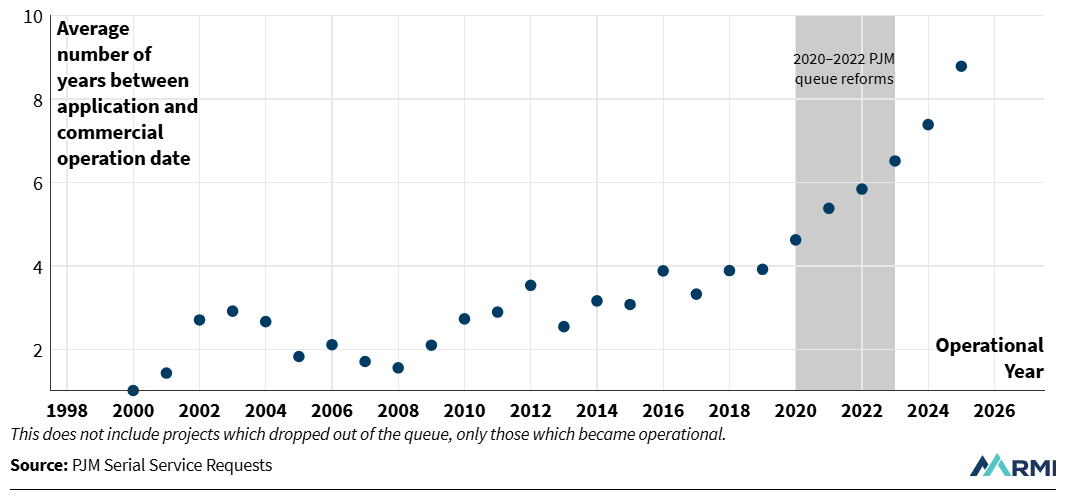
While the issue here is a backlog, the real issue is the price clearing mechanism. Each year, they hold an auction for utilities to bring power online. Operators like to keep a 20% reserve in case of issues in certain areas, but the latest auction hit the price cap and had a record low reserve. Estimates for the clearing price were much higher than the price cap, meaning there wasn’t enough incentive for new power generation to come online.
The tremendous demand for AI data centers is running into an antiquated power generation system that is not being responsive. The argument is that higher clearing prices result in unwanted price increases to consumers, but the result is an increasingly stressed grid and a non-market dynamic.
Goldman Sachs estimates that US data center power demand is forecast to more than double from 31GW in 2025 to 66GW in 2027. This is largely a regional phenomenon and helps us figure out that most of the commercial electricity demand growth is from new data center activity. Data centers fall under the commercial electricity basket and show tremendous growth post-pandemic, compared to growth rates seen prior. With the data center buildout accelerating,
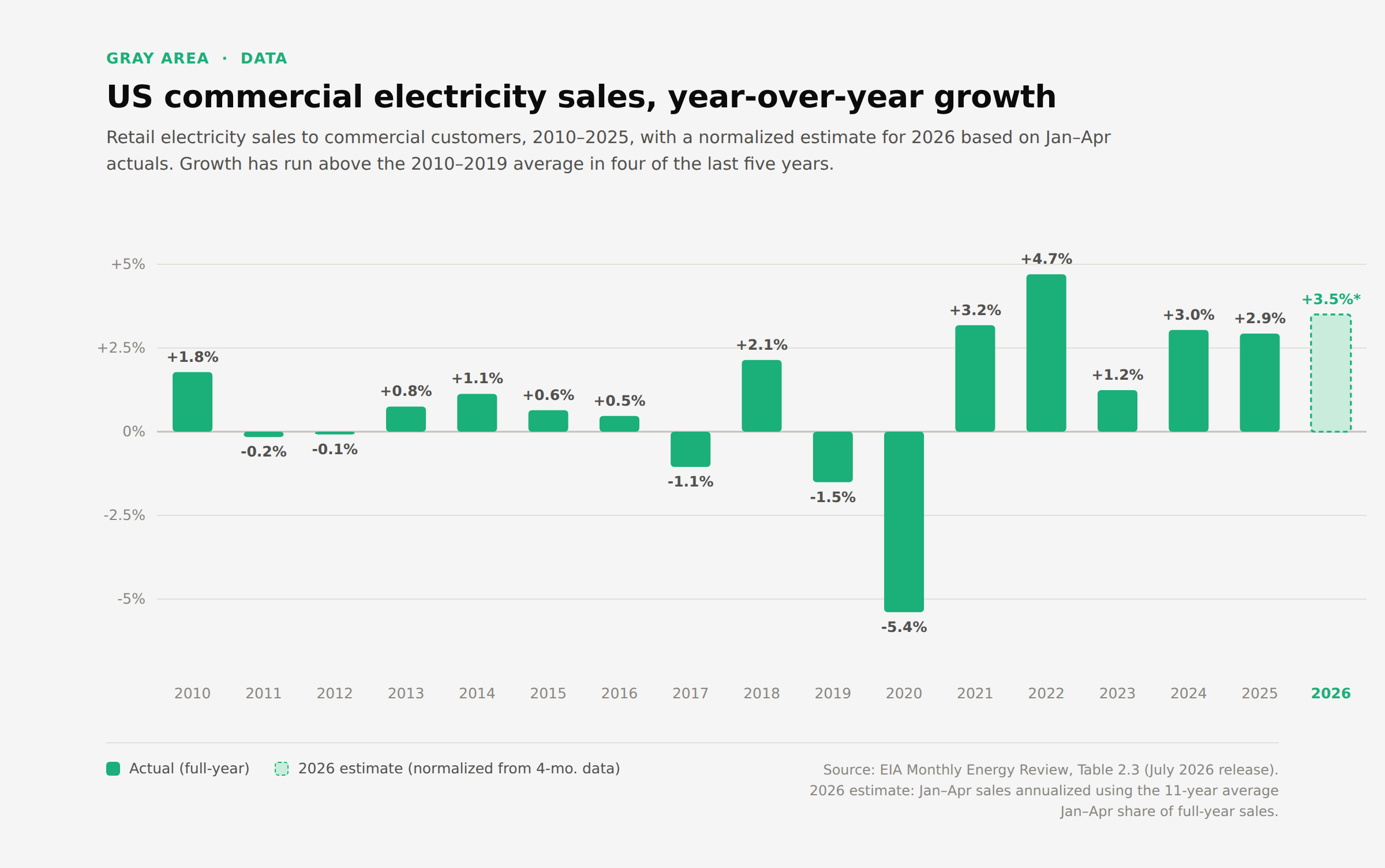
So what can stop the fear that data centers will suck up all the electricity and increase costs on consumers? There are three: incorrect estimates, efficiency gains, and the inevitability of markets to persist despite government intervention
Estimates
EIA’s own 2001 Annual Energy Outlook projected 2020 electricity demand roughly 25-30% above what actually materialized that year. Forecasts today likely discount macro environments, forecast linearly, and become excited by a hot new technology. RMI’s research suggests that utilities have also over-forecasted peak demand for over a decade. If a utility overcommits capacity, waste is shed at additional cost to consumers. If a utility under-commits capacity, there are blackouts and major grid distress.
Today, the interconnection queue and data center load figures are more like wish lists than actual commitments. LBNL shows the queues are enormous, but the historical completion rate for queued projects is low. Many entries are speculative, duplicated across multiple utility territories by the same developer shopping for the best site, or filed to reserve a place in line before a project is fully financed. This phantom load is a real problem that makes predictions and estimates difficult for all parties, not to mention the significant number of data center projects experiencing delays. These could include political backlash/moratoriums, supply constraints, or permitting issues.
Efficiency Gains
It’s easy to assume that as NVIDIA chips continue getting better and more efficient, as cooling systems innovate, and AI models improve software efficiency, that power demands may not be as high as expectations suggest because the per-unit efficiency rises. This is a trap, and a phenomenon called Jevons Paradox arises.
Jevons observed that more efficient coal engines in 19th-century Britain increased total coal consumption, not lowered it. Efficiency lowered the effective cost of the service, bringing in users faster than the per-unit savings. This paradox argues against my point initially, because as AI and the infrastructure improve, it will get cheaper, bringing in more use cases, and keeping the energy demand.
What I think people miss is that efficiency will not be a demand shift, but a geography shift. As AI becomes cheaper from efficiency gains across the technology space, more users will have access. Specifically, they will have access on local devices, whether that be small devices or smaller community data centers. Instead of decreasing the overall electricity demand, it changes where that demand comes from. Instead of a large queue on PJM, the load will be more distributed around the country, similar to how electric vehicles are broadening their footprint from a few cities to nationwide.
Shifting Bottlenecks
The last point has been made well by Doomberg and SemiAnalysis. Bottlenecks are only bottlenecks until someone finds a solution. Is a crackhead going to call it quits when drugs become illegal? To be clear, I’m not saying AI companies are crackheads or doing anything illegal per se, but that they are going to desperately look for alternatives.
If PJM has an eight-year backlog of the power generation needed, you go to another provider. If that provider/state bans data center construction, you build your own. This is called behind-the-meter solutions (power generation and storage systems located on the customer’s side of the utility meter). Not without its own backlash, companies are now constructing their own power generation plants for their data center projects.
Natural gas in the Permian Basin has become the hotspot. Natural gas is a growing byproduct of oil production in the US's largest oil region. Since it is a gas, it requires specific complex infrastructure to transport to other areas, let alone leave export terminals. With prices often in the negatives in some oilfields, it is the perfect place to take advantage of cheap energy.
Texas has put temporary freezes on data center connections, but has not banned them. New regulations on interconnections in Texas have actually incentivised behind-the-meter even more. Finally, the avoidance of many federal regulations in Texas has been another driver of this approach. Ultimately, the data centers will go to where they can begin as quickly and cheaply as possible. The market will find a way, regardless of things like price controls in PJM. The crackhead will get his crack.
Conclusion
Bottlenecks are like whack-a-mole; eventually you either win or become overwhelmed. Data center projects are playing whack-a-mole with grid operators and state governments to get the quickest and cheapest electricity.
While interconnection queues are a huge issue now, as efficiency gains from hardware and software revolutionize AI, electricity demanded from AI will geographically expand over time, reducing localized power burdens. This is just like the technology improvements of the computer/internet revolution or even the geographic proliferation of electric vehicles from select cities to the whole nation.
On top of all that, estimates of demand tend to be overestimates. On one side you have analysts and companies bought into the AI mania and excitement, and on the other, utilities overestimating so they aren’t the ones in the news and in the courtroom when there is a grid blackout.
All of this to say that I’m not as worried about data centers sucking up all of the electricity and making your bills go up as I would be about the government artificially creating energy shortages or debasing your hard-earned savings with inflation and taxation. This whole article is important, but doesn’t even scratch the surface of the largest reason data centers likely don’t suck up as much electricity as the mainstream suggests, and that is the capital/debt cycle.
-Grayson
If you would like to see how these concepts relate to a real portfolio that takes macro risks like this into account, is simple, and provides better risk-adjusted returns than traditional buy-and-hold or retirement strategies, please consider upgrading to access the model portfolio.
Socials
Twitter/X - @graysonhoteling
Email - thegrayarea55@gmail.com
Archive - The Gray Area
Notes - The Gray Area
Promotions
Sign up for TradingView
For educational and entertainment purposes only. The Gray Area should not be taken as financial advice.